Tutoring vs. Language learning apps, which is the most effective way to learn a language?
Compare tutoring and language apps for workplace French: apps are affordable and scalable for basics; tutoring builds advanced, job-specific fluency — use both.

Tutoring vs. Language learning apps, which is the most effective way to learn a language?
When it comes to learning French in the workplace, especially under Quebec's Bill 96 requirements, businesses face a key choice: tutoring or language learning apps. Here's a quick breakdown:
- Tutoring: Offers personalized lessons, immediate feedback, and tailored instruction for workplace needs. However, it's costly, hard to scale for large teams, and scheduling can be challenging.
- Language Learning Apps: Affordable, accessible 24/7, and scalable for large groups. These apps are great for basic skills but struggle with advanced speaking, writing, and workplace-specific tasks.
Key takeaway: Apps are cost-effective for foundational skills, while tutoring is better for advanced proficiency. For the best results, combining both methods may be the way forward.
Quick Comparison:
| Feature | Language Learning Apps | Tutoring |
|---|---|---|
| Cost | $7–$15/month | $5–$100/hour |
| Scalability | High | Low |
| Feedback | Instant, basic | Detailed, in-depth |
| Workplace Focus | Limited | Strong |
For Quebec businesses, balancing cost, accessibility, and proficiency goals is key to meeting Bill 96 standards.

Traditional Tutoring: Pros and Cons
Benefits of Traditional Tutoring
In light of Bill 96's stringent language requirements, traditional tutoring remains a trusted option for workplace French training, offering personalized and immediate guidance. One of its greatest strengths is real-time feedback - tutors can correct errors in pronunciation, grammar, and vocabulary on the spot, which is incredibly effective for language improvement [8]. Nadia Helal, a seasoned English and French language teacher, emphasizes this point:
Immediate feedback is most beneficial for improving one's pronunciation, grammar, and vocabulary [8].
Tutors also adapt lessons to suit specific business needs, whether it's crafting French product descriptions or managing French-language social media accounts. This custom approach ensures employees are equipped to comply with regulatory demands [9]. In fact, research reveals that 85% of learners value human interaction as essential for mastering a language, with 7 out of 10 students highlighting the importance of guidance for both pronunciation and grasping cultural nuances [12].
Another key benefit is accountability. Regular sessions provide structure and motivation, which are particularly important for adult learners juggling multiple responsibilities. Achieving Level B proficiency in French requires an average of 48 weeks of intensive training (35 hours per week), while reaching Level C demands an additional 24 weeks [5]. Tutors help learners stay on track with these demanding goals.
However, despite its advantages, traditional tutoring comes with notable challenges that limit its scalability and accessibility.
Limitations of Traditional Tutoring
Cost is a major hurdle. Workplace French training in Quebec's public sector often costs ten times more than private-sector alternatives, and the return on investment is frequently underwhelming [1]. With the province's extensive language training needs, affordability and scalability remain pressing issues.
Another limitation is the reliance on small group sizes, typically 1–3 people, which makes it difficult - and expensive - to scale for larger teams [1]. Additionally, low-intensity programs often fail to deliver meaningful progress, contributing to a 23% dropout rate in workplace French courses [1]. Benoît Dubreuil, Quebec's French-language Commissioner, critiques this approach:
A policy that consists of admitting to the workplace a large number of workers who don't understand French, and then offering them a low-intensity program to learn it, is not compatible with the objectives of the Charter of the French Language [1].
Adult learners also face scheduling conflicts and fatigue. Balancing tutoring sessions with work and caregiving responsibilities often leads to burnout and higher dropout rates [10]. Compounding this issue, the prevalence of English in many workplaces hinders learners from practising their French skills outside of lessons, further undermining progress [1].
These challenges underscore why many employers are exploring alternative methods to meet French training requirements in professional environments.
Language Learning Apps: Pros and Cons
Benefits of Language Learning Apps
Language learning apps have revolutionized workplace French training by making it more accessible and scalable. With the global online language learning market projected to hit $22.8 billion in 2024, it's no surprise that around 67% of language learners now rely on mobile apps as their primary study tool [13]. For businesses striving to meet the requirements of Bill 96, this shift offers a practical solution.
One of the biggest advantages of these apps is their 24/7 availability. Employees can practise whenever it suits them - during lunch breaks, on their commute, or even while waiting for a meeting. This flexibility is especially helpful for adult learners juggling work and family commitments.
Cost is another major factor. Apps provide a way to train large teams at a fraction of the cost of traditional classroom-based methods [13]. Many apps use AI-driven features like adaptive learning algorithms to adjust lesson difficulty and provide focused reviews [14][15]. They also include speech recognition to give instant pronunciation feedback, boosting engagement by over 30% [13][14][16].
To enhance retention, these apps employ techniques like spaced repetition, retrieval-based learning, and multisensory encoding, which have been shown to deliver strong results (effect size of g = 0.88) [7][4]. Automated reporting features further support compliance with Bill 96 [14][17].
Younger employees, particularly Gen Z, are drawn to the bite-sized, gamified content these apps offer, such as quizzes and short challenges. In fact, 40% of Gen Z learners prefer this type of learning format [13]. While these advantages make apps appealing, they do have their limitations, especially when it comes to more advanced language skills.
Limitations of Language Learning Apps
Despite their strengths, language learning apps fall short in some key areas, particularly for professional language training. One major issue is the gap between receptive and productive skills. While apps are excellent for building vocabulary and improving reading comprehension, they're less effective at developing speaking and advanced writing skills - both of which are crucial for workplace communication [19]. This shortfall can make it harder for businesses to meet the strict proficiency standards set by Bill 96.
Studies reveal that learners often achieve an "Intermediate Low" level in reading but only a "Novice High" in listening after completing basic courses [18]. Motivation can also be a challenge - only 22% of learners in one study met their 34-hour semester usage goal [19].
"Duolingo is essentially a vocabulary game that lacks context, simulations, and methods to reinforce long-term retention" [6].
Another drawback is the lack of cultural context. Many apps fail to simulate real-world scenarios, such as negotiating with French-speaking clients or understanding Quebec-specific expressions, which are essential for workplace integration.
Finally, classroom-based instruction consistently outperforms apps when it comes to developing listening and speaking skills [19]. For businesses aiming to comply with Bill 96, relying solely on apps may not be enough to meet the required language proficiency levels.
How should you learn a new language? Self study vs tutors vs group lessons!
Side-by-Side Comparison: Tutoring vs. Language Learning Apps
When it comes to workplace French training, comparing tutoring with language learning apps reveals clear differences in cost, scalability, personalization, and feedback.
Cost is one of the most noticeable differences. Language learning apps generally cost between $7 and $15 per month for premium subscriptions, with some offering lifetime access for a one-time payment ranging from $150 to $400 [21][22]. On the other hand, tutoring sessions can cost anywhere from $5 to $100 per hour on platforms like Preply [2]. While apps are budget-friendly, the higher hourly rates for tutoring can make it less feasible for training larger teams.
Scalability and availability also set these options apart. Apps are designed for 24/7 access on virtually any device, making them immediately available to employees whenever needed [3][4]. In contrast, tutoring requires scheduling sessions, pairing employees with suitable tutors, and handling potential variations in teaching quality [2][8]. These differences are particularly relevant for businesses aiming to meet Bill 96 requirements, as they must weigh the benefits of on-demand accessibility against the value of personalized instruction.
The real distinction lies in personalization and feedback quality. Apps use adaptive algorithms to adjust difficulty based on user performance, but they often follow a generic structure with broad categories like work, travel, or school [11]. Tutors, however, can customize lessons to fit specific job roles, such as preparing for client negotiations or industry-specific presentations. As Agos from The English Farm puts it:
If you have never interacted with a real person in your target language, are you ready to deliver a presentation in another language at work? For professionals, this could mean the difference between winning or losing an important account [11].
Without practising with a real person, many professionals may find themselves unprepared for high-stakes tasks like delivering presentations - tasks that can make or break client relationships.
Feedback methods further differentiate the two. Apps provide instant corrections for vocabulary and pronunciation, which can be helpful for quick learning. However, they lack the depth of feedback that tutors provide, particularly when it comes to tone, cultural nuances, and professional soft skills [11][20][22]. While an app can confirm your grammar is correct, it won't guide you through the subtleties of formality or relationship-building in a professional setting.
When you compare the two side by side, the strengths and limitations of each become apparent:
| Feature | Language Learning Apps | Traditional/Online Tutoring |
|---|---|---|
| Cost | Low ($7–$15/month) | High ($5–$100/hour) |
| Scalability | High; available 24/7 on any device | Low; requires scheduled sessions |
| Personalization | Limited; algorithm-driven, general categories | High; tailored to specific roles and needs |
| Feedback | Instant; machine-based corrections | In-depth; includes tone, cultural context, and soft skills |
For businesses working toward Bill 96 compliance, the choice often depends on employees' existing language skills. Apps are ideal for building foundational vocabulary and promoting "linguistic security." However, achieving the professional proficiency often required for workplace compliance - like Levels B or C - usually calls for the structured, high-feedback environment that tutoring offers [5]. Combining both methods can create a more effective and well-rounded French training program for the workplace.
Francoflex: Combining the Best of Both Methods

Francoflex blends the tailored guidance of tutoring with the flexibility and reach of language learning apps. By merging live tutoring sessions with on-demand, AI-powered materials, it creates a balance between human interaction and adaptable learning. With the help of Madame AI, employees receive daily, customized lessons tailored to their language level, native language, and workplace needs. The curriculum focuses on practical, real-world scenarios - like role-playing project kick-off meetings or understanding workplace hierarchies. Companies can even upload their own terminology databases, ensuring employees learn the specific French vocabulary they'll need on the job [11]. This approach tackles the limitations of single-method learning strategies.
Francoflex also uses AI to improve both compliance and learning outcomes. For regulatory compliance, the platform automates personalized francization reporting, making it easy to track employee progress. It also offers AI-driven practice sessions for OQLF exam preparation, targeting individual skill gaps and providing real-time feedback on pronunciation and grammar. These focused sessions address the weaknesses typically seen in app-only learning models.
The platform is designed to scale effortlessly, accommodating anywhere from 25 to 50,000 employees. With quick 10–15 minute sessions, scheduling conflicts are minimized. In fact, research from a 12-week study found that 60% of participants improved their oral proficiency by using a language app for just 10 minutes a day [23].
Conclusion: Which Method Works Best?
For businesses in Quebec navigating the requirements of Bill 96, digital language tools stand out for their scalability and convenience. While traditional tutoring offers a more personalized approach, its high costs make it impractical for training large workforces. The sheer expense of providing thousands of hours of tutoring for potentially hundreds of thousands of employees is simply not sustainable when compared to more affordable app-based solutions.
Language learning apps address these challenges effectively. They provide flexible, on-demand access to lessons that employees can fit into their busy schedules. These apps often feature short, manageable lessons and come at a fraction of the cost of tutoring, with monthly subscriptions typically priced between $6.99 and $30. Notably, a study revealed that 60% of participants improved their oral proficiency after using a language app for just 12 weeks [24].
The advantages of affordability and accessibility are further reinforced by insights like this:
"Learning French is increasingly a priority for individuals who face French-language barriers and seek to participate in broader Québec society and the labour market." – Provincial Employment Roundtable (PERT) [10]
To meet compliance standards and promote smooth workplace integration, employers need language training tailored to specific job requirements. Digital platforms excel in this area, offering consistent, on-demand learning opportunities that avoid the inefficiencies of fragmented regional training programs. These tools provide the continuous support adult learners need to succeed.
FAQs
What's the best way for businesses to combine tutoring and language apps to improve French proficiency?
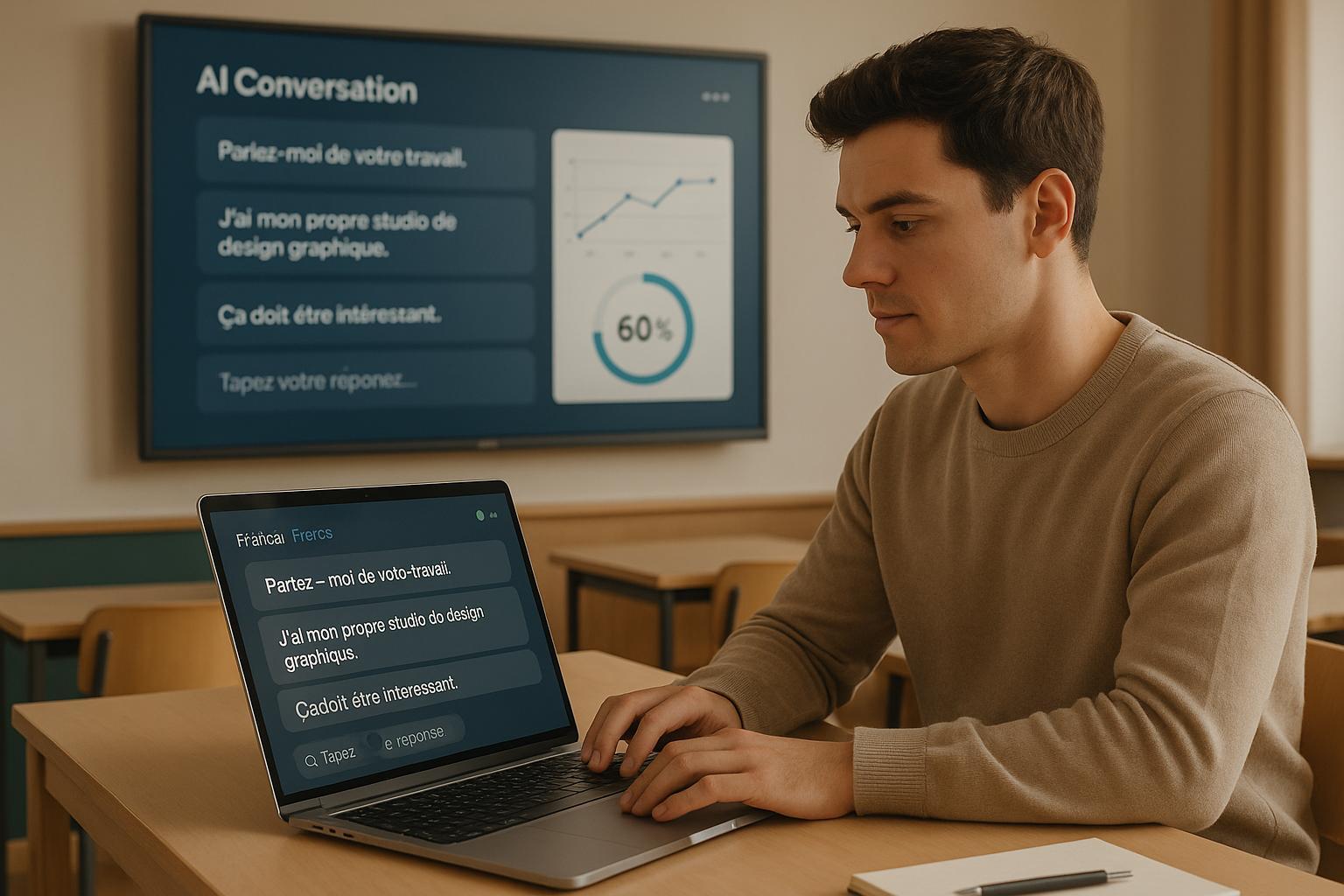
Businesses can see stronger language-learning outcomes by pairing language apps with tutoring in a well-planned, complementary manner. Language apps are excellent tools for daily practice, offering features like vocabulary exercises, AI-driven conversation practice, and grammar corrections. These apps let learners progress at their own speed while providing valuable insights through analytics.
Tutors can then leverage this app-generated data to design highly tailored sessions. They can address specific challenges such as pronunciation, advanced grammar, or workplace-related language needs. For example, employees might use an app daily to build their foundation and then attend weekly or bi-weekly tutoring sessions to fine-tune their skills. This blend of technology and personal interaction combines the flexibility of apps with the depth of human guidance, helping employees achieve faster and more lasting French proficiency in professional environments.
What challenges do language learning apps face in workplace language training?
Language learning apps have become a go-to option for their convenience and affordability, but they often fall short when it comes to workplace training. One major drawback is the lack of real-time interaction and feedback. This gap can leave users struggling with critical skills like pronunciation, speaking confidence, and grasping nuanced language - abilities that are essential in professional environments. On top of that, the self-motivation required to stick with these apps is a challenge, and many users quit before reaching a level of functional proficiency.
Another issue is the generic nature of most app content. They rarely address specific workplace needs or legal requirements, such as Quebec's Bill 96. While these apps might help expand vocabulary, they often fail to develop the oral communication and listening skills needed for job-specific tasks. Add in the demands of busy work schedules and other responsibilities, and it becomes clear why apps alone aren't enough for professional language training.
Why is personalized feedback crucial for learning a language in professional settings?
Personalized feedback plays a key role in language learning within professional settings because it hones in on the exact skills and terminology required for effective workplace communication. By focusing on areas like industry-specific vocabulary, appropriate tone, and grammar, it equips employees to confidently manage tasks such as client conversations, preparing compliance documents, or drafting internal communications.
What makes this feedback so impactful is its ability to speed up learning by targeting individual strengths and weaknesses. This approach minimizes repeated mistakes, builds confidence, and prepares employees to use the language effectively in practical, on-the-job scenarios - whether they're speaking, writing, or handling complex tasks. Immediate, context-aware corrections ensure that these language skills directly enhance workplace performance.