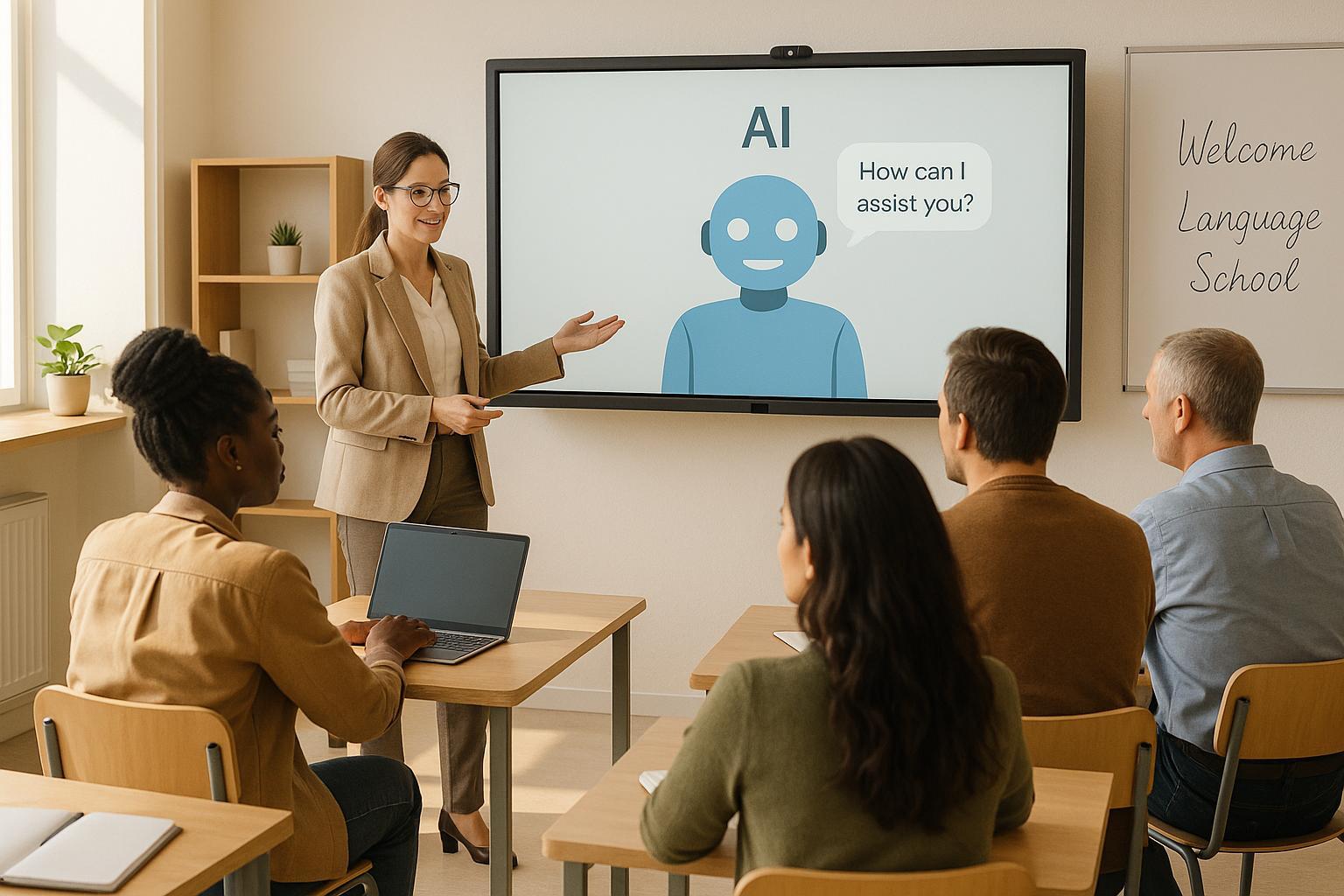
From Practice to Proficiency: How AI Speeds Up Student Progress in Language Schools
AI tools speed workplace French proficiency with personalized practice, progress tracking for compliance, and teacher-led oversight to protect privacy.

From Practice to Proficiency: How AI Speeds Up Student Progress in Language Schools
AI is transforming language learning in Canada, especially in response to workplace demands like Quebec's Bill 96, which requires French proficiency. Tools like Francoflex offer tailored training for job-specific tasks, real-time feedback on pronunciation and grammar, and compliance tracking for businesses. Studies show AI-driven platforms improve speaking fluency by up to 23% in just eight weeks. These tools also help learners prepare for professional communication through adaptive tests and personalized content aligned with Canadian workplace standards. However, privacy and human oversight remain critical to ensure ethical use and accurate assessments. AI is not replacing teachers but enhancing their ability to meet the growing demand for effective language training.

3 Key Tools Heading The AI Language Learning Revolution
Setting Learning Goals for Canadian Workplace Requirements
Meeting workplace language standards means equipping individuals with the skills to handle essential tasks in a professional setting. AI tools are transforming how language schools identify these needs, whether it's delivering safety briefings, engaging with clients, or participating in meetings. By zeroing in on these specific tasks, learners move closer to achieving practical language proficiency and meeting workplace expectations.
Identifying Workplace Language Outcomes
With the help of AI-powered Natural Language Processing (NLP) and Data-Driven Learning (DDL), real-world workplace documents are analysed to determine the vocabulary, phrases, and communication tasks relevant to professional settings [4]. Instead of relying on generic lessons, learners can focus on the language they'll actually need on the job.
The "Language for Success" framework connects workplace tasks to Canadian Language Benchmarks (CLB) levels [5]. For instance, a customer service representative might need to resolve complaints at a CLB 7 level, while a supervisor may require the skills to conduct performance reviews at CLB 9. AI platforms take it a step further by gathering data on each learner's job role and personal learning profile, creating tailored content that aligns with their specific workplace needs [3].
Using AI to Assess Proficiency Levels
Once learning goals are established, AI-powered adaptive tests assess all four language skills - reading, writing, speaking, and listening. These assessments provide precise, unbiased measurements aligned with standards like CEFR or CLB [6]. Unlike traditional evaluations, AI eliminates the risk of subjective bias and delivers instant certification upon test completion.
As EF Corporate Learning highlights:
"With AI now a part of language assessments, English [and French] speakers can test all four language skills - reading, writing, speaking, and listening - without fear of human error or bias." [6]
In September 2025, the Translation Bureau of Canada began testing GCtranslate, an AI tool trained specifically on Canadian data. It's already being used by organizations like Canadian Heritage, Finance Canada, and the RCMP to ensure translations meet Government of Canada language and terminology standards [7]. This showcases how AI can scale compliance with official language requirements.
Tracking Progress with AI Data
AI tools also track learner progress through measurable metrics that reflect workplace readiness. These include pronunciation accuracy (key for client-facing roles), task completion time (efficiency in communication), vocabulary mastery (especially for industry-specific terms), and error rates (critical for professional correspondence) [6].
In virtual classrooms, AI collects real-time data on performance, such as speaking time, grammar accuracy, and interaction patterns [6]. This continuous feedback replaces traditional one-off tests, offering a more dynamic way to measure improvement. With nearly 75% of employees lacking adequate language skills facing limited workplace opportunities [6], accurate progress tracking becomes crucial - not just for meeting compliance but for advancing careers. By combining demographic insights with AI proficiency data, organizations can pinpoint communication gaps and ensure their teams meet language standards required under regulations like Bill 96 [6].
Creating an AI-Supported Practice Routine
Building a consistent practice routine with AI tools can significantly speed up the transition from basic skills to workplace proficiency. With 73% of Americans believing that AI simplifies language learning [8], and French ranking as the third most common language students use AI to study [8], it's clear that AI-supported practice is becoming a staple in Canadian classrooms and workplaces. By incorporating AI into daily routines, learners can target specific skills like conversation, pronunciation, and writing.
Practicing Conversations with AI Agents
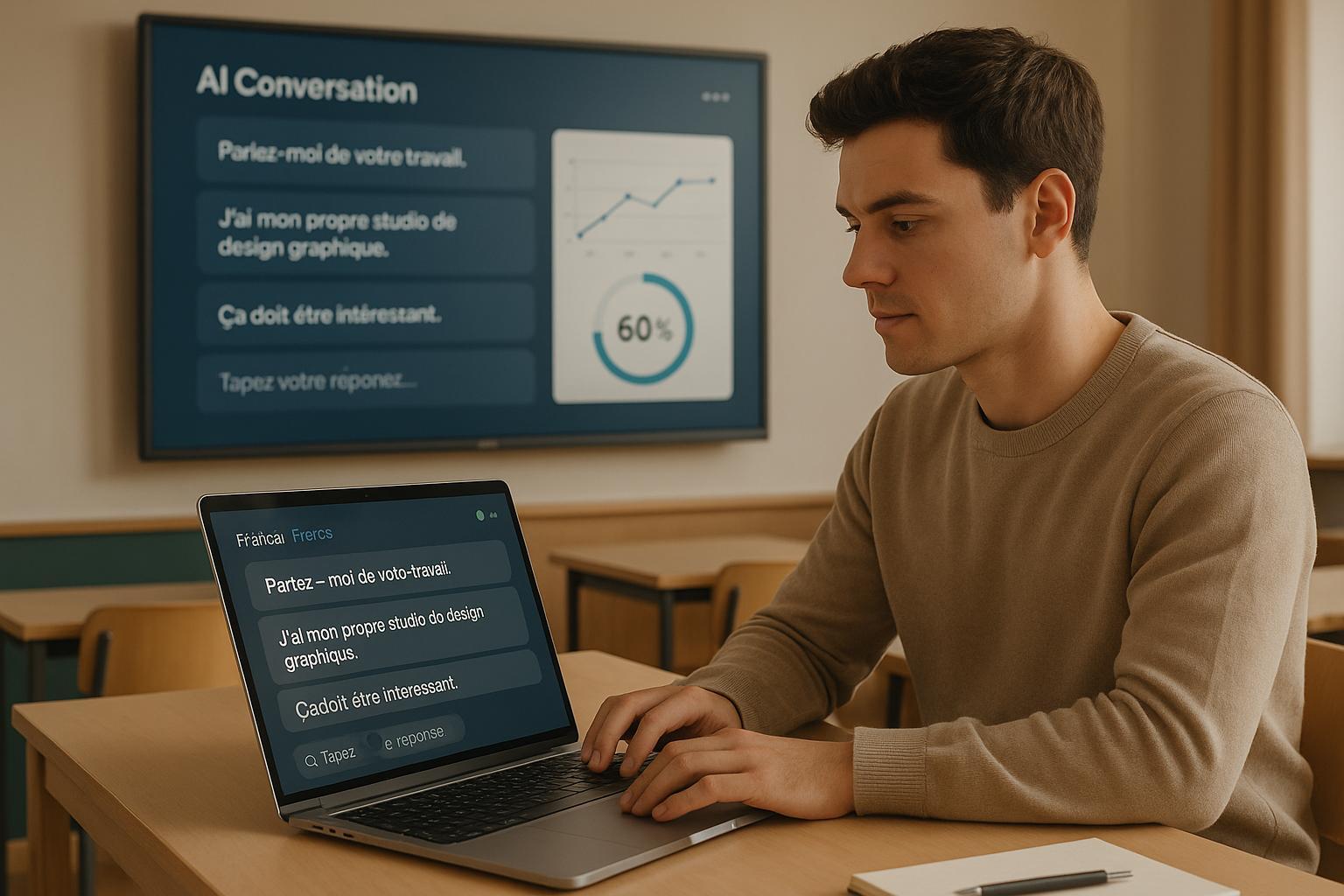
Conversational AI offers a unique way to simulate real-world workplace scenarios without the fear of judgment. This is especially helpful for meeting Canadian workplace language needs. Learners can practise client calls, team meetings, or casual office conversations using tools like ChatGPT or Gemini. These platforms are available 24/7, making it easy to squeeze in practice during lunch breaks, commutes, or after hours [4][8].
A 2024 study by Gualán and Ramírez highlights the impact of AI in language learning. Students using the Gliglish AI platform saw their speaking scores improve by over 75%, with grammar scores rising from 1.00 to 1.76, pronunciation from 0.73 to 1.50, and vocabulary richness from 0.82 to 1.59 [2]. These results underscore how repeated, on-demand practice can fast-track language skills.
Anita Derecskei, Tutor Development Senior Specialist at Preply, puts it well:
"AI tools... are available 24/7, so you can go back as many times as needed and ask follow-up questions without having to raise your hand or wait for someone to be available to help." [8]
AI agents also provide a safe environment to refine professional speech. Learners can rehearse workplace scenarios - like delivering safety briefings or managing customer complaints - until they feel confident and natural.
Improving Pronunciation with Speech Recognition
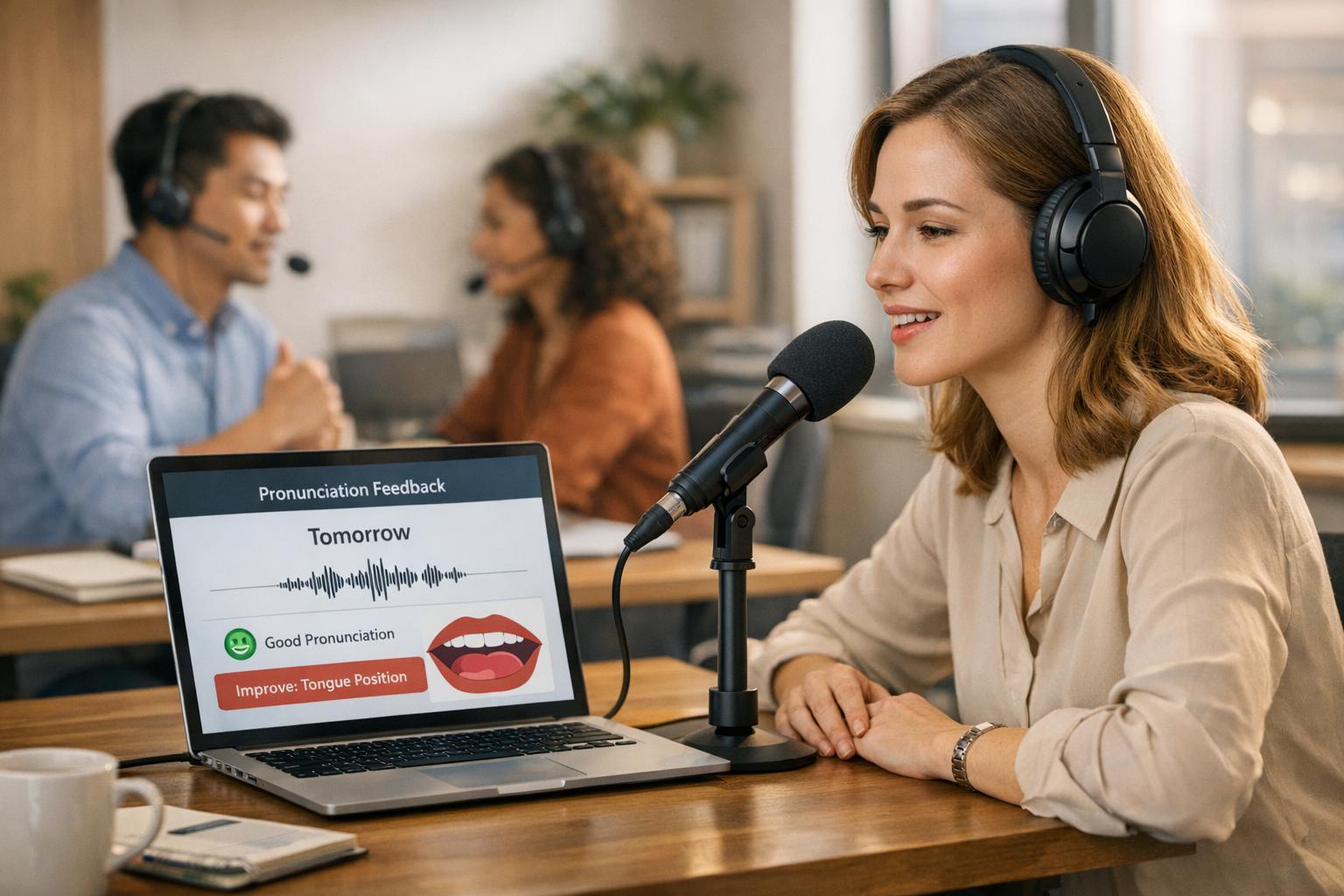
Good pronunciation is vital, especially for roles that require direct client interaction. Speech recognition tools give instant feedback, helping learners master the 36 distinct phonemes of French, including its unique vowel and consonant sounds. They also help with rules like liaison, where silent end-consonants are pronounced when followed by a vowel [10]. For practical use, learners can try reading workplace documents aloud into apps like Speechnotes, which transcribe speech into text. Reviewing these transcriptions helps identify recurring pronunciation errors [4].
AI tools also support "shadowing" exercises, where learners repeat phrases immediately after hearing them pronounced correctly [9]. Short, daily sessions can help build the muscle memory needed for clear and accurate speech.
Using AI Writing Tools for Workplace Communication
Once speaking and pronunciation improve, honing written communication becomes the next priority. Writing in a professional context requires precision, as errors can undermine credibility. Tools like Grammarly catch grammatical mistakes in real time and suggest professional synonyms or alternative sentence structures [8]. Research shows that 44.8% of students use AI for editing essays or reports, while 42% rely on it for summarizing or understanding complex materials [8]. In the workplace, this translates to drafting client emails, preparing meeting notes, or writing incident reports with immediate feedback on grammar, tone, and clarity.
For the best results, learners should draft their content first and then use AI to refine it, rather than generating it entirely through AI. As Derecskei explains:
"This cognitive involvement is what leads to long-term learning... in those moments when the brain struggles – to think of the right vocabulary term, grammar rule, or next step in a math problem – is when the long-term real learning happens." [8]
Studies suggest that combining AI feedback with teacher input leads to greater writing improvements than relying on teacher feedback alone [4]. This hybrid approach allows instructors to focus on more nuanced aspects of communication, while AI takes care of repetitive grammar corrections. However, privacy is a key concern - learners should ensure that AI tools comply with workplace data policies, especially when handling sensitive documents. With 78% of students already cross-referencing AI outputs with trusted sources [8], verifying AI-generated suggestions is quickly becoming a standard practice.
Using Francoflex for Personalized Learning

When choosing an AI platform for workplace learning, it's essential to find one that not only scales with your organization's needs but also offers tools for personalized learning and compliance. Francoflex is designed specifically for Canadian workplaces, combining AI-driven personalization with compliance tools that meet Quebec's language requirements. It adjusts to each learner's native language, current proficiency level, and job role, ensuring that the training directly improves workplace communication. This system builds on earlier AI-supported practice routines, transforming them into a scalable and individualized learning solution.
Customizing Learning Paths by Job Role
Francoflex creates learning paths tailored to the specific needs of each employee, whether they work in customer service, healthcare, construction, or another field. The platform focuses on vocabulary and phrases relevant to their daily tasks. For instance, a construction worker might practise safety briefings and equipment-related terminology, while a customer service representative would work on client interactions and resolving complaints. The conversational AI is available 24/7, adapting to the learner's schedule and native language.
As José, a small business owner, shares:
"This will help my business grow as I'll be able to send my workers to client's homes knowing they can communicate properly in French." [11]
This tailored approach doesn't just enhance individual learning - it scales efficiently to support entire teams.
Scaling AI Solutions for Large Teams
A standout feature of Francoflex is its ability to deliver personalized learning experiences for both small teams and large enterprises, scaling from a single employee to teams as large as 50,000. The platform tracks individual learning hours and overall team progress, providing managers with actionable insights to monitor and guide their workforce.
Sonia B., a Director of Human Resources, highlights this advantage:
"Je ne veux pas que mes employés soient sur une liste d'attente de Francisation Québec pendant des mois." [11]
By offering immediate access to training, Francoflex eliminates long waiting periods and aims to bring employees into compliance within six months.
Compliance and Reporting Tools
Francoflex also simplifies the compliance process by generating detailed reports that businesses need for OQLF certification renewal. These reports track key learning metrics and integrate seamlessly into an organization's official francization plan. Stéphane, a company president, emphasizes the platform's value:
"Francoflex ensures I stay compliant at a small cost." [11]
With its reporting tools, Francoflex streamlines administrative tracking, making it easier for businesses to meet Quebec's language requirements while focusing on their core operations.
Monitoring Progress and Using AI Responsibly
This section explores how performance data and ethical safeguards come together to guide student progress in AI-driven language learning. By combining AI analytics with privacy protection and human oversight, language schools can enhance learning outcomes while respecting students' rights under Canadian law.
Understanding AI Learning Data
AI platforms can track various metrics, such as time spent on tasks, types of errors (e.g., misinformation, omission, addition), self-correction speed, and accuracy in grammar and pronunciation. These metrics provide a clear snapshot of a student's progress, helping instructors identify which grammar rules or vocabulary sets need extra focus.
Research supports the effectiveness of this approach. A meta-analysis of 40 studies found that AI tools have a high effect size of 0.812 on English language learning outcomes compared to traditional teaching methods [12]. For example, if data highlights frequent errors in verb conjugation during workplace scenarios, instructors can introduce targeted exercises to address these issues before moving on to more complex communication tasks. This creates a responsive system where automated insights and human expertise work hand in hand.
Creating Feedback Loops with AI Data
The best results come from combining AI-generated insights with teacher expertise. Studies show that blending AI feedback with teacher input significantly improves learning outcomes [4]. In June 2023, the Canadian government invested $2 million in Voilà Community Help's "Artificial Intelligence for Official Languages" project. This initiative, involving over 35 school boards across the country, aims to use AI to analyse diverse learning styles and deliver personalized content [3]. Minister of Official Languages Ginette Petitpas Taylor emphasized the importance of such initiatives, stating:
"It's through innovative projects like this that we can continue to improve education programs and offer young people opportunities to grow and flourish in French." [3]
While AI-generated data enables tailored instruction, protecting learner privacy is a critical component of responsible implementation.
Protecting Privacy and Maintaining Compliance
Canadian privacy laws, such as the Personal Information Protection and Electronic Documents Act (PIPEDA), set strict guidelines for how organizations collect, use, and share personal information [13][14]. Schools must obtain clear, informed consent from students, explaining data collection practices in plain language and avoiding manipulative designs.
By 2025, 46 Canadian organizations, including both small businesses and multinationals, will have adopted the Voluntary Code of Conduct on generative AI to address legal and ethical challenges [13]. Canada's Compendium of Best Practices underscores this commitment:
"AI systems should be designed in ways that support appropriate transparency and provide workers with clear information about their use, such as with informed consent." [13]
Human oversight remains vital for key decisions, such as proficiency assessments or workplace placements. While AI can identify patterns and suggest changes, instructors must review these recommendations to ensure accountability. Schools should conduct Algorithmic Impact Assessments before introducing new monitoring tools to identify risks to equality, dignity, and autonomy. Additionally, learners should have the option to challenge AI-supported decisions and request human reviews. Collecting only essential, anonymized data further ensures compliance with regulations like Bill 96 while upholding ethical standards expected in Canadian workplaces.
Conclusion
AI is reshaping how Canadian language schools help students progress from basic language skills to workplace readiness. By leveraging adaptive learning techniques and delivering instant, detailed feedback, AI-powered platforms create personalized learning experiences that keep students motivated without overwhelming them. The results speak for themselves - studies show that students using AI tools perform significantly better than those in traditional classrooms, with a notable effect size of 0.812 on learning outcomes [12]. For AI-guided, individualized instruction, this impact grows even more, reaching 1.18 [1]. These findings highlight not only the effectiveness of AI in education but also its potential for broader adoption through strategic support from governments and organizations.
Government funding for AI-driven education demonstrates Canada's dedication to bilingualism and workplace integration. These investments provide practical solutions for meeting high standards, as seen in platforms designed to scale with the demands of businesses.
For schools and businesses working to comply with Quebec's Bill 96, AI offers a practical way forward. Tools like Francoflex provide the scalability and compliance features needed to meet OQLF certification standards, all while delivering tailored workplace training.
The human element remains crucial. While AI is excellent at analysing patterns and adjusting content difficulty, teachers play a key role in reviewing AI recommendations, confirming assessments, and ensuring compliance with Canadian privacy laws. As discussed earlier, balancing adaptive technology with privacy safeguards is essential. By combining AI insights with teacher expertise and prioritizing learner privacy through informed consent and minimal data collection, schools can create a learning environment where students can thrive in mastering French.
FAQs
How does AI protect privacy and ensure ethical use in language learning?
AI-powered language learning tools are designed with privacy and ethics at their core, ensuring users feel secure and respected. Data protection is a top priority. Personal details, such as speech recordings and performance metrics, are encrypted and stored safely, with access granted only when users explicitly agree. Learners are also kept in the loop about what data is collected, how it's used, and are given options to export or delete their information.
To promote fairness, developers adhere to AI ethics principles, working to eliminate bias related to accents, dialects, or cultural backgrounds. By using advanced methods like explainable AI, these tools make decisions - such as recommending tailored content - clear and easy to understand. This transparency builds trust and minimizes the risk of unfair treatment. Together, these steps create a learning environment where students can focus on mastering a language without concerns about security or bias.
How can AI help improve language skills for the workplace?
AI has the potential to transform workplace language skills by sharpening reading comprehension, boosting speaking fluency (including pronunciation), and enhancing listening abilities. It also plays a key role in improving professional writing, whether it's crafting clear emails or preparing polished reports. Plus, it helps users develop industry-specific vocabulary tailored to their professional needs.
On top of that, AI-powered tools offer real-time conversational practice, allowing individuals to confidently navigate workplace interactions. These capabilities make AI a powerful ally for professionals aiming to meet language requirements with precision and ease.
How does AI enhance traditional language teaching in schools?
AI brings a new dimension to language learning by offering customized learning paths and instant feedback that extend beyond what a classroom teacher can typically provide. With adaptive tools, the content adjusts to match each student's progress, zeroing in on areas that need extra attention. Plus, AI-powered platforms give immediate feedback on pronunciation, grammar, and vocabulary, enabling learners to practise and refine their skills anytime, even outside regular class hours.
On top of that, AI helps lighten teachers' workloads by automating tasks such as creating quizzes, grading assignments, and organizing learning resources. This allows educators to dedicate more time to activities that truly make a difference, like facilitating discussions, delving into cultural nuances, and offering personalized support. By combining the strengths of human teachers with advanced AI tools, this blended approach creates a learning experience that's both engaging and efficient, helping students make quicker strides in mastering a new language.